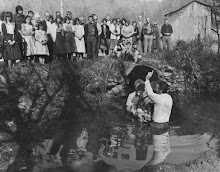
I often ask myself, when the work of the day has settled down and things grow quiet and still, how did I get there? How did any of us get there, to that river valley in eastern Kentucky and western West Virginia, scattered along these creeks and streams like so many seeds, sprouting wildly in the deep shadows of hollows that for centuries knew only the footfall of bear and fox and mountain lion, and for more centuries after that the occasional band of Shawnee hunters, building fires in the shelter of overhanging rocks? Perhaps as they slept, they dreamed of their homes, along the Ohio River near Portsmouth, or west, in Clark County, the village they called Eskippakithiki, the Place of Blue Licks. They had other names that hide behind the places we know: Eskalapia, Tywhapita, Tyewhappety. Or the name they gave, half mockingly, to the Kanawha River - Chinotahishetha, which seems to mean, "He, the Shawnee, is guarding that which is his."
Then they were gone, defeated at the Battle of Point Pleasant, overwhelmed by history, and soon the land itself was neatly divided into tracts by Thomas Jefferson's Land Ordinance of 1785 and sold for as little as $1 an acre. After that, my ancestors came, Hatfield and Ball and Blankenship, Farley and Ferrell and Dotson, Runyon and May, McCoy and Smith, beginning, timidly, in the late 1790s and gaining momentum in the first decade of the new century. Hungry for land and, I can only assume, space, primal emptiness, they come, clearing back the virgin forest, building homes, planting things, naming things. By 1810, they've established themselves in the hollows of Pike County, from Buskirk on the banks of the Tug River, all along Blackberry Creek, Pond Creek, Pinsonfork, McVeigh. And there, despite the steep hillsides and narrow hollows, the thin soil, the difficulty of getting anywhere, the isolation, they survive. One might say, looking at the census rolls from 1820, 1830, 1840, seeing the number of children in their homes grow to 10, 12, 15, 18, that they even prospered. Certainly, as William Faulkner might say, they endured.
From that point on, I can trace their comings and goings by way of census rolls, church records, the occasional deed or court document. I can watch them intermarry and mingle, see how their children spread out along the hollows, each generation carving the land into smaller (and less productive) portions, but at the same time note how the family networks grow more complex and intertwined. I don't really know anything about these people. They are little more than names, dates scribbled in census books, but something of them survived in their children and grandchildren and great grandchildren; in the songs my great grandmother might have sung to herself as she weeded her garden, in the stories she told about her great grandfather, in the knowledge my grandfather had of the hillsides around his house - where to find gingseng, which tree the squirrels came to feed at early in the morning, where the chestnut trees had been before the blight in 1933.
I know a few things for certain. They came and they stayed. They changed the land and the land changed them, individually and collectively, until some times it is difficult for me to tell where one ends and the other begins. I honestly can't say that I understand the forces that drove them to make the choices they made, but I can say without exaggeration that I am the result of those choices. All I have of them are my own personal memories and the more tenuous memory of historical research, the bone-deep memory of culture, which molds us the way the contours of the hillsides direct the path of the streams. But this memory, whether personal or historical or cultural, is important, since it is the one way that we can keep faith them and with the Shawnee who were here before them - we too, in our stories and our songs and our boxes of old photographs and faded documents, guard that which is ours.
Tuesday, February 2, 2010

Monday, September 21, 2009
Three Marriages, A Funeral, a Coronation, and an Indiscretion
One strand - Runyon. My great grandmother Gladys, a Runyon before she married Leonard Smith (historically speaking the Smith's were Johnny Come Lately's to the county, not arriving until the 1860s or so). I grew up across the road from where her father, Orison Peter Runyon, had built the family homeplace sometime before 1900. He had come across the mountain from Pond Creek, where his grandfather, Adron Runyon, had functioned as something like the local gentry. Adron had come to Pond Creek early, among the first wave of settlers, and he owned a good deal of land. He had 14 children with his wife, Jennie Maynard, and at least three children with their live-in housekeeper, Mary Ann May. The fact that one of his great grandchildren by way of Mary Ann May was Leonard Smith, who married one of his great grandchildren by way of his wife, Jennie, was not something mentioned, if known, by my family. Did my great grandmother Gladys know that she and her husband, Leonard, shared a great grandfather? If she did, the knowledge did not get passed along as living memory. It did not, until now, become a story that we could tell about ourselves. I'm not sure whether or not it illuminates anything, but it seems to shed some light on the Runyon character. We begin, apparently, here:
The historical record of the Runyon's begins with a wedding. It passes along the way through a series of indiscretions that splits a family into two halves, one legitimate and one not, and then resolves itself, so to speak, in another wedding.
It has been proven by Runyon researchers that Vincent Runyon and Ann Boucher were founder's of most, and many believe all, of the Runyon family in America. Vincent was a French Hugeunot from Poitou France and Ann's family was from England. Many believe that Ann's family too had French roots, but this is a point of discusssion amongst researchers.
The first reference to Vincent in America is in 1668, in a 'marriage license' given by Philip Carteret, the young Governor of East Jersey. The document is on file in the office of Secretary of State of New Jersey, at Trenton and reads as follows Source Runyon24-2231.FTW:"To any of the Justices of the Peace or Ministers of the Province of New Jersey: Whereas I have received information of a mutual agreement between Vincent Rongnion, of Portiers, in France, and Ann Boutcher, the daughter of John Boutcher, of Hartford, in England, to solemnize marriage together, for which they have requested my lycense, and there appearing no lawful impediment for the obstruction thereof, these are to require you or eyther of you, to joyne the said Vincent Rongnion and Ann Boutcher in matrimony, and them to pronounce man and wife, and to make record thereof, according to the laws in that behalf provided, for the doing whereof this shall be to you or eyther of you a sufficient warrant. Given under my hand and seal of the Province, the 28th day of June, 1668, and the 20th year of the raigne of our Sovereign Lord Charles the Second, of England, Scotland and Ireland, kind, defender of the faith, etc.
(signed) Ph. Carteret
This couple were joyned in matrimony by me the 17th of July, 1668.
(signed) James Bolton ...".
LINK
The historical record of the Runyon's begins with a wedding. It passes along the way through a series of indiscretions that splits a family into two halves, one legitimate and one not, and then resolves itself, so to speak, in another wedding.
Subscribe to:
Comments (Atom)